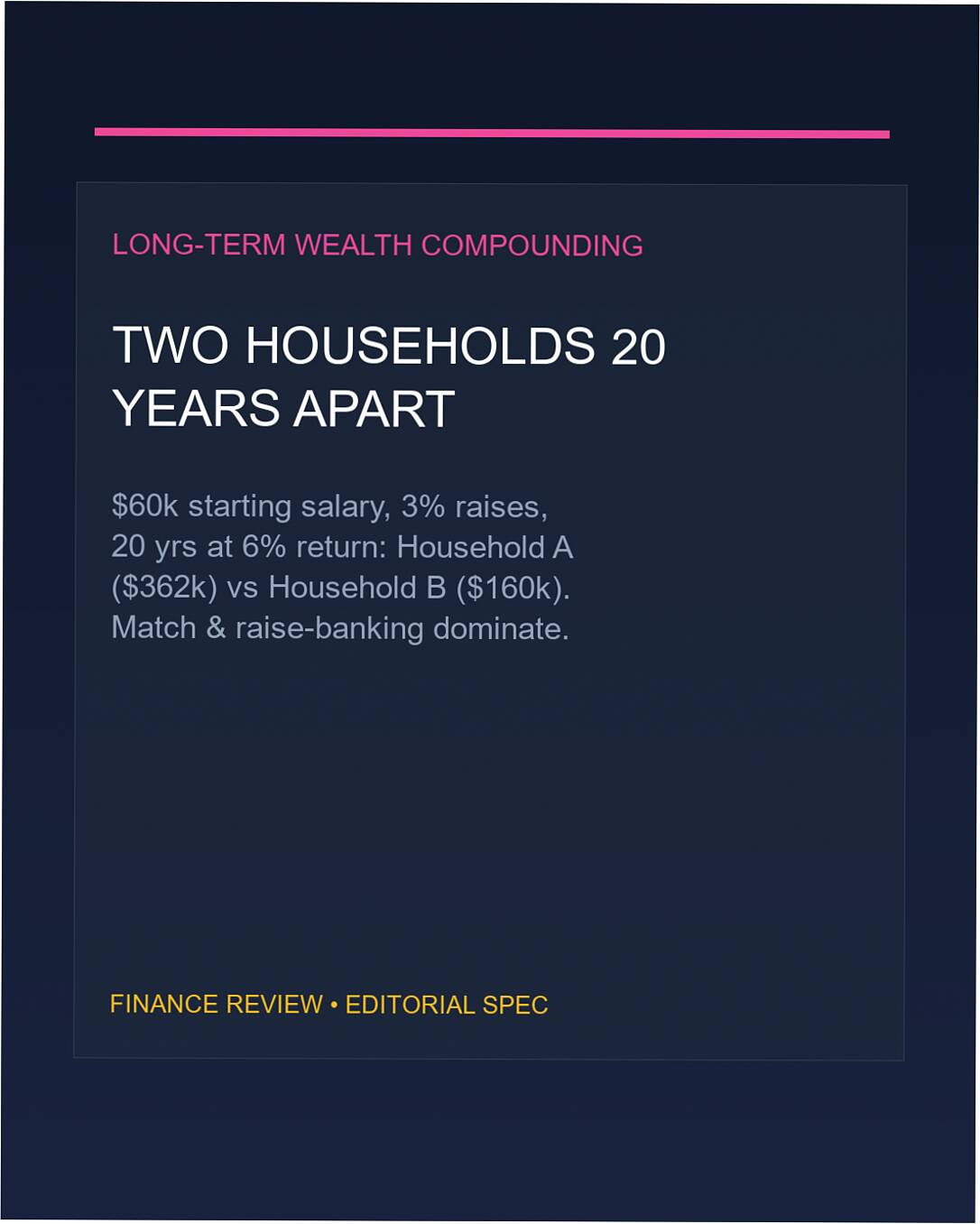
Consider two households starting with identical $60,000 salaries and 3% annual raises. Both save 6% of income over twenty years at a 6% gross return.
Household A takes a 3% employer match and pays 0.25% fund fees. Household A carries no card debt and banks half of raises to reach a 10% savings rate. Household B skips the match, pays 1.00% fees, stays at 6%, and carries $6,000 in card debt at 22%.
After twenty years, Household A accumulates $362,074, while Household B reaches $160,118. Mathematical analysis reveals the employer match added $86,736 and raise-banking added $101,865, while fee differences accounted for $13,354.
These outcome gaps reflect differences in financial access and default automation rather than personal character.
Which of those decisions is still open for you?
(For educational purposes only. Not financial advice.)