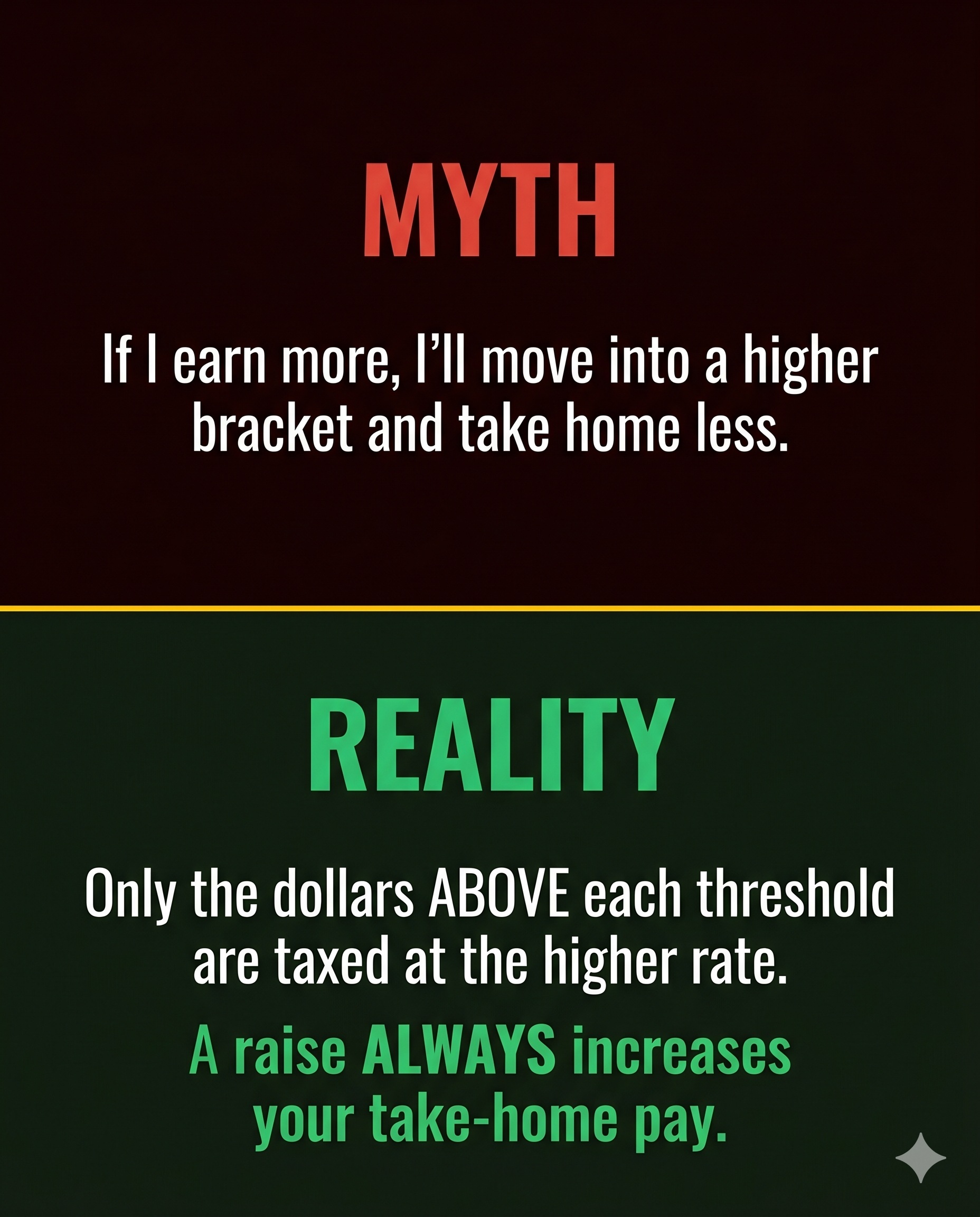
A raise will never leave you with less money. Ever.
That is not an opinion. It is how the tax code is structured. Tax brackets are marginal — meaning only the dollars above each threshold get taxed at the higher rate. If you earn $95,000 and get a $5,000 raise, you do not owe 22% on all $100,000. You owe 22% only on that last $5,000. The rest of your income is taxed exactly as it was before.
Here is what that actually means in dollar terms. Someone earning $95,000 in the 22% bracket who gets a $5,000 raise pays roughly $1,100 more in federal taxes on that raise — and takes home approximately $3,900 more than they did before. Not less. More. Always more.
This myth is costing people real money. Not in taxes — in the raises they turned down, the promotions they avoided, the freelance work they left on the table because they were afraid of “moving into a higher bracket.” There is no scenario in the U.S. tax system where earning more results in a smaller paycheck.
Share this with anyone who has ever hesitated to take a raise because they were worried about taxes. The math takes 30 seconds to understand and it changes everything.
Save this post — the next time someone brings this up, you will want it.
Did you believe this before today?